Tell us about the job
Takes about a minute. No obligation.
A furnace repair call in Marshall County starts with the unit itself: its age, its filter history, how well the original install was done. 75 severe weather events were recorded in Marshall County, Oklahoma between 2015 and 2024. At that rate, severe weather is something this county sees, but it does not define how hard heating equipment runs year to year. A contractor checking a failed heat exchanger or a burned-out igniter is looking at cumulative wear from use and time, and the weather record gives them little reason to look elsewhere first.
Half the homes in Marshall County, Oklahoma were built in 1985 or earlier (2020-2024 ACS 5-year). A house built that long ago was outfitted for equipment that no longer exists, and what runs in it today is at minimum its second or third generation of furnace. When a contractor opens the unit, the question that determines how the repair goes is whether the parts it takes are still in production. Manufacturers phase out components on their own schedules, and a furnace serving a house this old sits well inside the window where that becomes a real problem rather than a theoretical one.
The Parts of a Furnace a Contractor Checks First
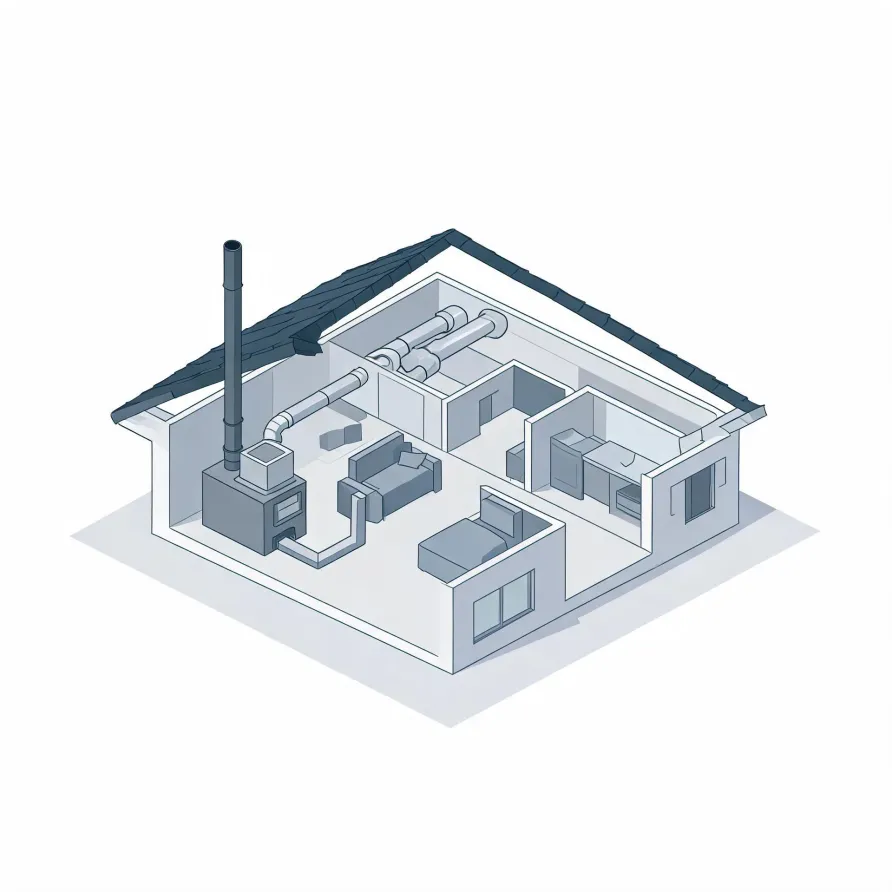
The furnace itself sits in a utility space, basement, or closet and is the piece a contractor goes to first. Inside it, the heat exchanger, burners, and blower motor each have a distinct job, and a fault in any one of them shows up differently. A cracked heat exchanger, a dirty burner, or a failing blower motor each produces its own set of symptoms.
The flue pipe runs from the furnace to an exterior vent and carries combustion gases out of the house. The thermostat on a living-room wall tells the furnace when to fire, and the air filter upstream of the blower keeps debris out of the cabinet. A contractor working through a repair will check all of these, because a problem in one can look like a problem in another.
The drawing shows a typical furnace layout, and a licensed contractor determines which parts and conditions apply to your specific home.
Get matched in Marshall CountyMarshall County, Oklahoma, by the numbers
75 severe weather events were recorded in Marshall County, Oklahoma between 2015 and 2024.
NOAA National Centers for Environmental Information, Storm Events Database, bulk CSV export, events 2015-01-01 through 2024-12-31.Half the homes in Marshall County, Oklahoma were built in 1985 or earlier (2020-2024 ACS 5-year).
U.S. Census Bureau, 2020-2024 American Community Survey 5-Year EstimatesMarshall County, Oklahoma holds 8,832 housing units (2020-2024 ACS 5-year).
U.S. Census Bureau, 2020-2024 American Community Survey 5-Year EstimatesOwners occupy 77.6% of the occupied homes in Marshall County, Oklahoma (2020-2024 ACS 5-year).
U.S. Census Bureau, 2020-2024 American Community Survey 5-Year EstimatesCodes & Standards Behind Furnace Repair in Marshall County, Oklahoma6 sourced rules and standards
What Happens When the Contractor Comes Out
Non-weatherized gas furnaces manufactured on or after November 19, 2015 must reach 80.0 percent AFUE.
Non-weatherized oil-fired furnaces manufactured on or after November 19, 2015 must reach 83.0 percent AFUE.
Mobile home gas furnaces manufactured on or after November 19, 2015 must reach 80.0 percent AFUE.
Non-weatherized gas furnaces manufactured on or after December 18, 2028 must reach 95.0 percent AFUE, up from the 80.0 percent minimum that applies to units manufactured before that date.
Licensing and Legal Requirements in Marshall County, Oklahoma
An Oklahoma mechanical licence is valid statewide, and a contractor licensed by a local authority who works only in that locality is not required to hold the state licence at all.
Oklahoma requires a Construction Industries Board licence for mechanical work: nobody may do or advertise mechanical work as a journeyman or contractor without the right licence.
Severe Weather Events in Marshall County
Oklahoma weather puts real hours on heating equipment. Every hard weather event your area sees is a demand spike, and demand spikes are where furnaces show their weak points.
75 severe weather events, 2015–2024. Source: NOAA National Centers for Environmental Information, Storm Events Database.